
Introduction
Small and medium-sized businesses (SMEs) often face a common challenge using multiple disconnected applications to manage daily operations. Sales, accounting, inventory, purchasing, and customer data remain scattered across different systems.
Odoo solves this problem by bringing every business function together on a single platform.
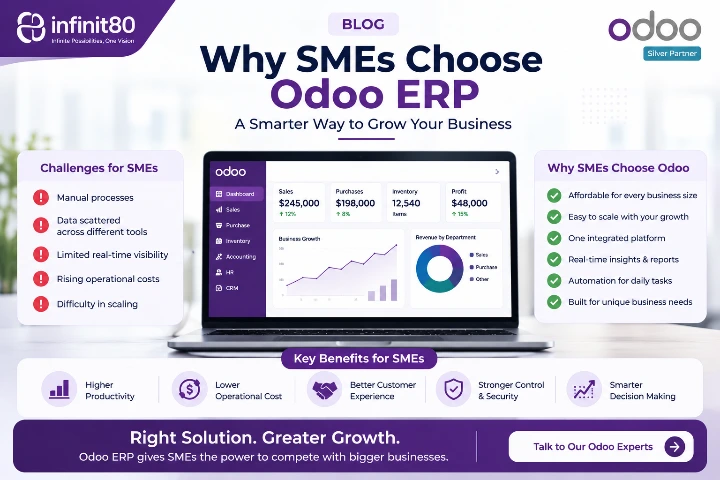
Challenges SMEs Face
- Manual processes
- Duplicate data
- Poor visibility
- Limited reporting
- Inventory inaccuracies
- Growing operational costs
- Difficult collaboration
Why Odoo is Perfect for SMEs
Affordable Investment
Businesses only pay for the applications they need.
Easy to Scale
Start with CRM or Accounting and expand as your business grows.
One Integrated Platform
No more switching between multiple software solutions.
Faster Decision Making
Real-time dashboards provide instant business insights.
Automation
Automate approvals, quotations, purchase orders, invoicing, reminders, and workflows.
Better Customer Experience
Track every customer interaction from lead generation to payment collection.
Industry Flexibility
Odoo adapts to manufacturing, trading, retail, healthcare, services, and many other industries.
Business Benefits
- Increased productivity
- Lower operational costs
- Improved inventory accuracy
- Faster order processing
- Better customer satisfaction
- Centralized data
- Real-time reporting
Why SMEs Prefer Odoo Over Traditional ERP
Traditional ERP systems often require significant investment, lengthy implementation timelines, and expensive customizations.
Odoo delivers enterprise-level functionality with greater flexibility, making it an ideal choice for growing businesses.
Conclusion
As SMEs grow, operational complexity increases. Odoo provides a scalable foundation that supports growth without forcing businesses to replace their ERP every few years.